
How to Find Your Ring Size Online Accurately
We've all been there—that slight pause before clicking "buy" on a ring you've fallen in love with online. The big question, how to find your ring size online, can feel a little daunting, but it’s actually way simpler than you might think. With the right tools (most of which you already have), you can get a reliable measurement from home using a printable sizer, a strip of paper, or even a ring you already own and adore.
Your Guide to a Perfect Ring Fit From Home
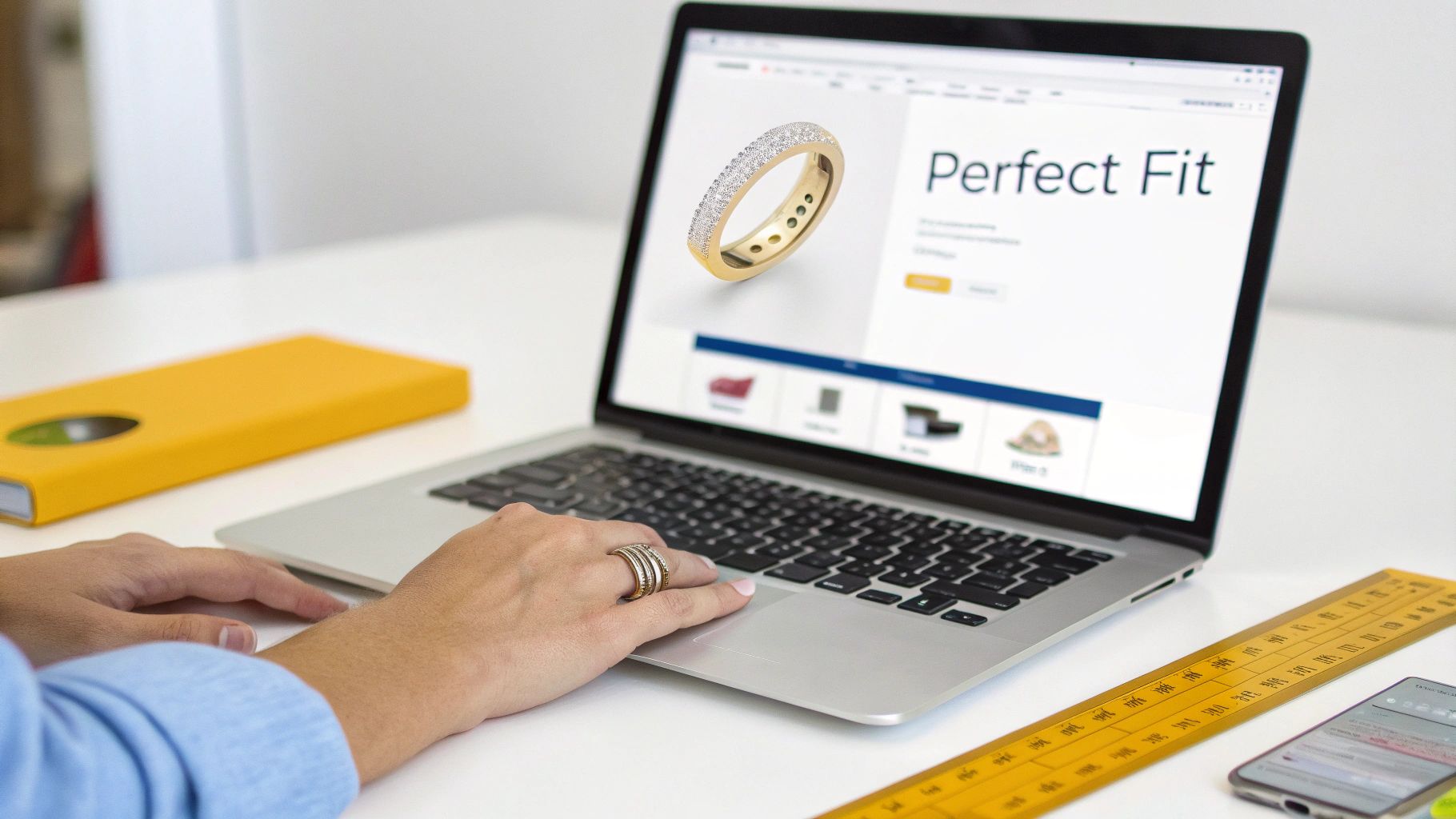
Finding your ring size is about more than just a number; it’s the key to avoiding the hassle of returns or paying for resizing down the road. While nothing beats the convenience of online shopping, it does introduce the challenge of getting that perfect fit without trying it on first. This guide is here to take the guesswork out of the equation.
Believe it or not, some studies show that up to 30% of online jewelry purchases end up being returned because of incorrect sizing. It's a huge headache for both shoppers and jewelers. In response, many online stores have created simple, effective tools to help you measure accurately right from your couch. You can learn more about how retailers are tackling ring sizing to make your experience smoother.
Getting your ring size right the first time transforms your online shopping experience from a gamble into a confident purchase. A comfortable, secure fit means you can wear your new piece with pride from the moment it arrives.
We'll walk you through the three most effective at-home methods. Each one is straightforward, so you can confidently pick the perfect piece from our collection at Precious Pulse Jewelry.
Which At-Home Sizing Method Is Right for You?
Not sure where to start? This table gives you a quick snapshot of the three main methods for finding your ring size, helping you pick the perfect approach for your needs.
| Method | Tools Needed | Best For | Accuracy Level |
|---|---|---|---|
| Printable Sizer | A printer and a credit card for scale | Anyone who wants a tool designed specifically for ring sizing | High (if printed correctly) |
| String or Paper | String, paper, a ruler, and a pen | A quick, accessible measurement when you don't have a printer | Medium (good for an estimate) |
| Existing Ring | A well-fitting ring you own and a ruler or sizer | Leveraging a known perfect fit to find your size for other fingers | High (very reliable) |
Each method has its strengths, from the precision of a printable chart to the convenience of using what you already have. Let's dive into how to use each one to get that perfect fit.
Getting it Right with a Printable Ring Sizer Chart
A printable ring sizer chart can be a surprisingly accurate tool, but its reliability comes down to one crucial detail: how you print it. If you get this first step wrong, everything that follows will be off.
The absolute most important thing you need to do is check the print scale the moment it comes out of the printer. Before you even think about cutting or measuring, grab a credit card or a ruler and lay it right on the chart’s scale guide. If it doesn't match up perfectly, the chart wasn’t printed at 100% scale, and any measurement you take will be useless. Go back to your printer settings, disable any "Scale to Fit" or "Fit to Page" options, and print it again until it's spot on.
Using the Two Main Chart Types
Most of these printable guides give you two ways to find your size: a little wrap-around sizer you cut out, and a chart of circles you can compare an existing ring to.
If you're using the wrap-around tool, I highly recommend printing it on a sturdy piece of cardstock instead of regular printer paper. Flimsy paper can stretch or crease, giving you a wobbly and inaccurate reading. Cardstock holds its shape, making it much easier to get a snug, true-to-size measurement.
For the circle chart method, you’ll need a ring that already fits you well. Place it directly over the circles on the page. You've found the right size when the circle is completely visible along the inner edge of your ring, with no gaps and no part of the circle being covered by the metal.
Here's a common mistake I see all the time: people use a really wide ring (anything over 6mm) with a standard chart. Wide bands fit much more snugly than thin ones, so you almost always need to size up a bit. Always check if the sizer you’re using is meant for a specific band width.
Avoiding Common Sizing Errors
Besides the print scale, a few other simple mistakes can throw off your measurement. When you're using the circle chart, make absolutely sure you're matching the inside of the ring to the circle, not the outside. If you accidentally include the thickness of the metal, you’ll end up ordering a ring that’s way too big.
It also helps to have a general idea of what's common. For instance, the most purchased ring size in the US is a size 7, with sizes 6 and 8 right behind it. Together, these three sizes make up over 70% of all ring sales. Knowing this can give you a good sanity check on your results.
Precision is everything when you're doing this at home. A correctly printed chart from a trusted source like Precious Pulse Jewelry can give you the confidence you need to make the right choice from our stunning collection.
Using the String or Paper Strip Method
No printer? No problem. The string or paper strip method is a classic for a reason—it’s a surprisingly effective way to measure your ring size with items you already have at home.
This technique is simple, quick, and discreet. That makes it perfect if you're planning a surprise, like picking out one of our classic bands from Precious Pulse Jewelry. The whole key to getting this right is making sure your measurement is snug, with no slack.
Nailing the Technique for an Accurate Reading
First, grab a thin strip of paper or a piece of string that doesn't stretch. Wrap it around the base of the finger you're sizing. You want it to feel firm but not uncomfortably tight—it should mimic how you’d want a real ring to fit.
Once it’s comfortably wrapped, use a fine-tip pen to mark the exact spot where the end overlaps. Precision is your best friend here. Even a single millimeter can be the difference between a perfect fit and a ring that’s just a bit too loose or tight.
After you’ve made your mark, lay the string or paper flat against a ruler. Be sure to use the millimeter side for the most accurate reading. Ring sizes are determined by very small increments, and millimeters give you the detail that inches just can’t capture.
One of the most common mistakes people make is forgetting about the knuckle. If your knuckle is noticeably larger than the base of your finger, you need to measure both areas. Your ring has to be big enough to slide comfortably over the knuckle, but not so loose that it spins around once it’s on.
This infographic breaks down the essential steps for getting a reliable measurement, whether you're using a printable sizer or adapting the process for a simple paper strip.
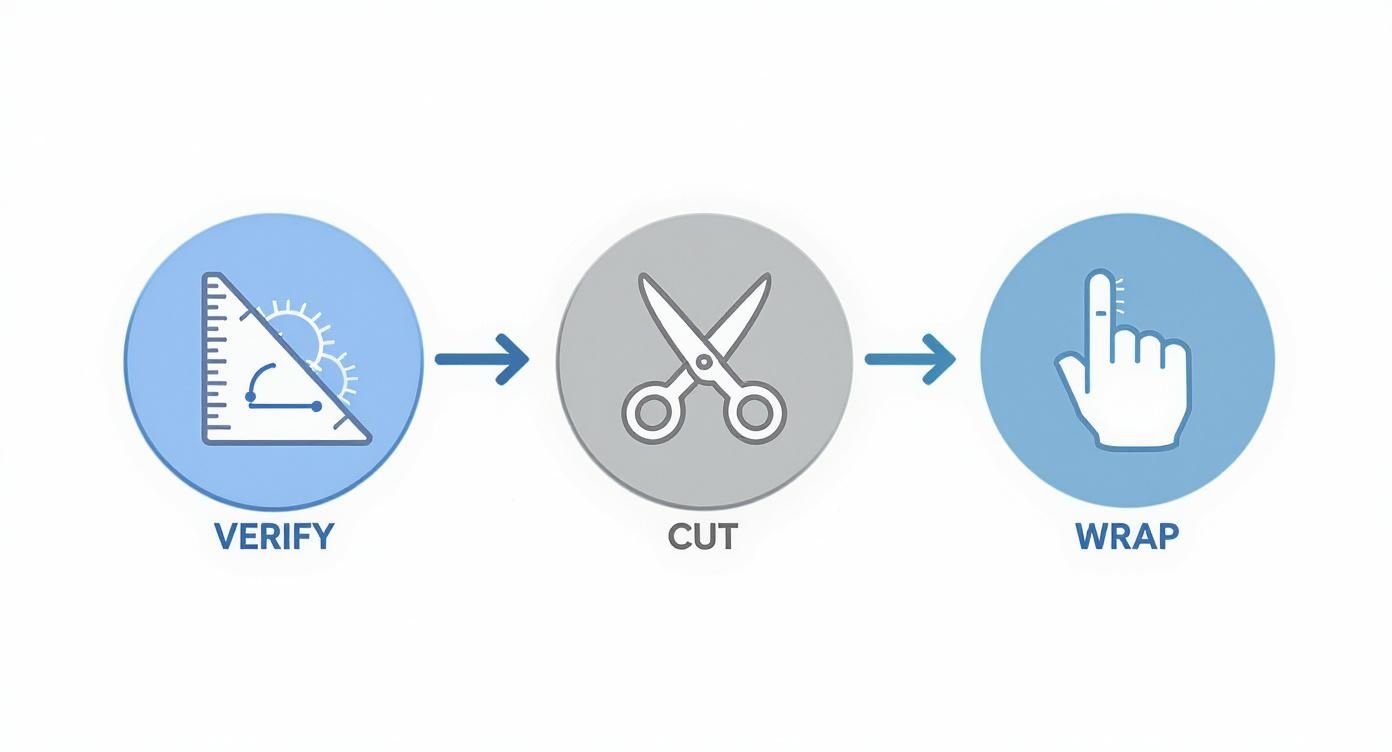
As you can see, the process is straightforward: verify your tool is to scale, cut it out, and wrap it carefully. Following these steps in order builds a reliable foundation for an accurate size.
Once you have your circumference measured in millimeters, the final step is to convert it into a standard US ring size. A conversion chart bridges the gap between your DIY measurement and your final purchase, giving you the confidence to order the perfect ring online.
From Millimeters to US Ring Sizes
Use this quick reference table to convert the circumference you measured with the string or paper method into its official US ring size.
| US Ring Size | Diameter (mm) | Circumference (mm) |
|---|---|---|
| 3 | 14.1 | 44.2 |
| 3.5 | 14.5 | 45.5 |
| 4 | 14.9 | 46.8 |
| 4.5 | 15.3 | 48.0 |
| 5 | 15.7 | 49.3 |
| 5.5 | 16.1 | 50.6 |
| 6 | 16.5 | 51.9 |
| 6.5 | 16.9 | 53.1 |
| 7 | 17.3 | 54.4 |
| 7.5 | 17.7 | 55.7 |
| 8 | 18.1 | 57.0 |
| 8.5 | 18.5 | 58.2 |
| 9 | 19.0 | 59.5 |
| 9.5 | 19.4 | 60.8 |
| 10 | 19.8 | 62.1 |
| 10.5 | 20.2 | 63.4 |
| 11 | 20.6 | 64.6 |
| 11.5 | 21.0 | 65.9 |
| 12 | 21.4 | 67.2 |
| 12.5 | 21.8 | 68.5 |
| 13 | 22.2 | 69.7 |
| 13.5 | 22.6 | 71.0 |
| 14 | 23.0 | 72.3 |
Just find your millimeter measurement in the "Circumference" column, then look to the left to find your corresponding US ring size. It's that easy
Measuring a Ring You Already Own
If you have a ring that already fits perfectly, you're in luck. Using a piece you know and love is hands-down one of the most accurate ways to find your ring size online. It completely removes the guesswork of measuring your actual finger, which can swell or shrink depending on the temperature, time of day, or even what you ate for lunch.
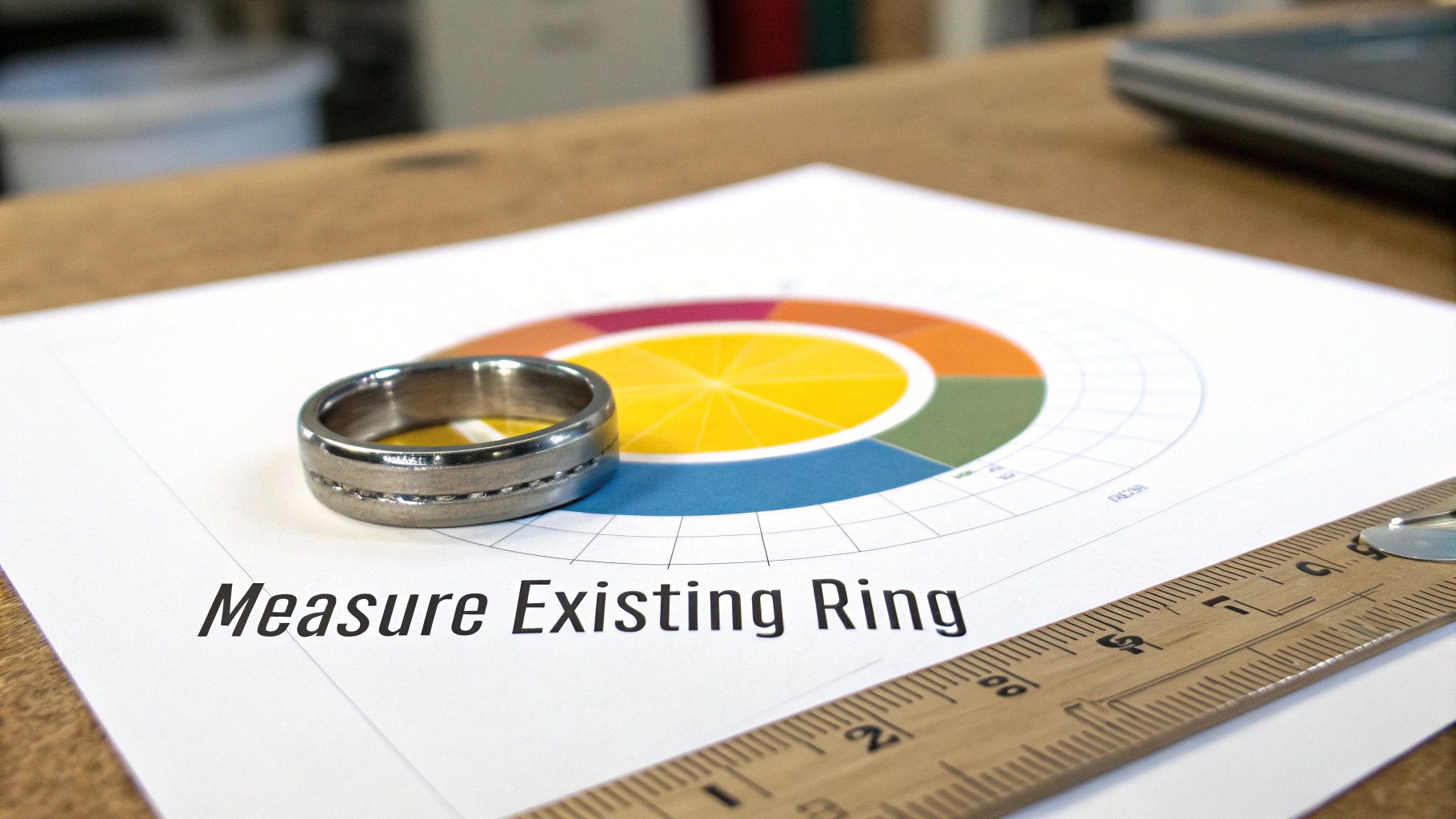
Instead of fussing with string, you're working with a proven, comfortable size. There are two really simple methods to nail this at home. The easiest way is with a printable ring sizing chart that has circles corresponding to each size. Just print it out, lay your ring over the circles, and find the one that lines up perfectly with the inner edge of your ring. You've found your match when the entire circle is visible right inside your ring, with no gaps.
Getting Precise with a Ruler
No printer? No problem. A good old-fashioned ruler works just as well.
Lay your ring on a flat surface and place the ruler directly across its center. You'll want to measure the internal diameter in millimeters—that's the distance from one inner edge to the opposite inner edge. The key here is to not include the metal of the band in your measurement. Once you have that number, you can pop it into our conversion chart above to find your US ring size.
A crucial tip I've learned over the years: always try to measure a ring that has a similar band width to the one you're planning to buy. A wide, chunky band fits much more snugly than a delicate, thin one.
For example, if you have your heart set on a minimalist solitaire ring, measuring a slim-banded ring you already own will give you the most accurate result. Using a thick band as your guide could trick you into ordering a size that ends up being too loose. It's a small detail that makes all the difference in getting that perfect, "just right" feeling.
For more in-depth advice, especially when it comes to something as important as an engagement ring, be sure to check out our complete engagement ring size guide.
Pro Tips for an Accurate Measurement Every Time
Knowing how to measure your finger is just the first step. The real secret to a perfect fit is knowing when and how often to do it. Think of it as the difference between a good guess and a guaranteed great fit every time you shop.
Your fingers are surprisingly dynamic, swelling in the heat and shrinking when it's cold. To get the most reliable reading, always measure your finger at the end of the day when temperatures are mild. Your finger is typically at its largest then, which helps you avoid picking a ring that feels great in the morning but uncomfortably tight by dinnertime.
Fine-Tuning Your Sizing Technique
Even with perfect timing, one measurement just isn't enough to go on. Consistency is your best friend when sizing a ring at home.
Don't just measure once and call it a day. Instead, take a measurement 3-4 times on different days and at various times. This simple trick helps you spot any outliers caused by temporary swelling from a salty meal, your hydration level, or a recent workout. It gives you a reliable average to work with. And remember to keep your units consistent—if you're switching between millimeters and inches, some general measurement conversion tools can be a lifesaver.
Pro Tip: Don’t forget about your knuckle! If it’s wider than the base of your finger, you need to measure both spots. The right size will be just large enough to slide over the knuckle without a struggle but snug enough that it won't spin around once it's on.
Special Considerations for Different Ring Styles
The style of the ring you're eyeing can dramatically change the size you need. A wide band—think anything over 6mm—takes up more real estate on your finger, creating a much snugger fit than a delicate, thin band would.
As a rule of thumb, it’s smart to go up by at least a half-size for these bolder, wider styles. This gives you the extra room you need for a comfortable fit that won't feel constricting. Many of the statement rings in our Precious Pulse Jewelry collection come with sizing recommendations for this very reason.
This kind of precision is more important than ever with the rise of smart rings. For these devices to collect accurate health data, they need a consistently snug fit. As the market for these gadgets grows, so does the need for reliable at-home sizing methods. Getting the size right from the start ensures your new tech performs exactly as it's meant to.
Answering Your Lingering Sizing Questions
Even after you've measured carefully, a few questions always seem to pop up. Getting these details right is the final step to picking a ring online that you know you'll love.
What if I’m Between Two Sizes?
This is probably the most common question we get. You measured, checked it twice, and you’re stuck right between a size 7 and a 7.5. So, what do you do?
When in doubt, always go with the larger size. It’s much easier (and cheaper) for a jeweler to make a ring slightly smaller than it is to stretch it or add metal to make it bigger. A little bit of wiggle room is also great for those days when your fingers naturally swell from heat or activity, ensuring your ring remains comfortable.
Do Different Ring Styles Need Different Sizes?
Yes, this is a big one that people often overlook. The width of the band dramatically changes how a ring feels on your finger.
- Wide Bands (over 6mm): Think of these like a wide-brimmed hat—they cover more real estate. Because they take up more space on your finger, they feel much tighter. We always tell customers to go up at least a half-size for these beefier styles to keep them comfortable.
- Thin, Dainty Bands: For these delicate bands, your true measured size is almost always the perfect fit. Our minimalist and stackable rings are designed to fit true to size for this reason.
A quick heads-up on international sizing: Standards can be completely different depending on where you're shopping. The US uses numbers, but the UK uses letters. If you're buying from an international brand, make sure you find their conversion chart to get the translation right.
So what happens if you did everything right and the ring still doesn't fit? Don’t sweat it, it happens. For small tweaks, our guide on how to resize a ring at home has some great DIY tips. But for anything more significant, a professional jeweler is the way to go to protect the ring and get that perfect, lasting fit.
At Precious Pulse Jewelry, we believe finding the perfect ring should be an exciting part of your story, not a stressful one. Now that you're armed with the knowledge to choose your size with confidence, go explore our collection of beautiful, affordable rings. Find your next favorite piece at https://preciouspulsejewelry.com.